Buying a lake lot near Dent can feel simple at first glance. You see the water, picture the cabin or home, and start planning the fun part. But with vacant lakeshore land, the real question is not just whether you like the lot. It is whether you can actually use it the way you hope. This guide will help you understand the local due diligence that matters most in Otter Tail County, so you can move forward with more confidence. Let’s dive in.
Start With Buildability
When you look at a lake lot near Dent, the first step is figuring out which rules apply. In Otter Tail County, land within 1,000 feet of a lake or within 300 feet of a river, or within the landward extent of a river floodplain, is generally treated as shoreland. That means shoreland permit review may apply before you build or change the site.
The next layer is jurisdiction. If the parcel is inside city limits, the city handles permits and property address questions. If it is outside city limits, Otter Tail County points buyers toward county processes for shoreland permits, septic permits, and address requests.
That distinction matters because a lot that looks buildable on paper may have a very different approval path depending on location. Before you spend too much time on design ideas, confirm whether the city or county is your first stop.
Know the Shoreland Standards
Not every waterfront lot meets today’s standards for a new home or cabin. In Otter Tail County, lots created after October 15, 1971 must meet minimum area and width standards, and only land above the ordinary high water level counts toward those minimums.
For single-family riparian lake lots, the minimums vary by lake classification:
- General Development: 20,000 square feet and 100 feet of width
- Recreational Development: 40,000 square feet and 150 feet of width
- Natural Environment: 80,000 square feet and 200 feet of width
Lot width must be met both at the ordinary high water level and at the building line. That is a big reason two lots with similar frontage can have very different building potential.
If public sewer is available, sewer-based standards may apply. If not, the lot also needs to work for septic under county and state rules. In practical terms, a lot can be wide enough on paper but still be difficult to build on if the septic layout is too constrained.
Understand the Ordinary High Water Level
One of the most important lines on a lake lot is the ordinary high water level, often called the OHWL. In Minnesota, this is the regulatory boundary used for many shoreline decisions, and local governments use it to determine setbacks.
That matters because your usable building area starts to take shape from this line, not just from where the grass meets the water on the day you visit. If the shoreline boundary is unclear, it is smart to sort that out early.
Lake classification also affects how far structures must sit back from the OHWL. Otter Tail County sets principal structure setbacks at:
- 75 feet on General Development lakes
- 100 feet on Recreational Development lakes
- 150 feet on Transition lakes
- 200 feet on Natural Environment lakes
The county also allows one water-oriented structure to be as close as 20 feet from the OHWL if it meets ordinance standards. Even then, other setbacks still apply for property lines, roads, and bluff areas.
Access Is More Than a Driveway
A common mistake with raw lake land is assuming shoreline access means build access. In reality, legal and physical access can shape the whole project.
Otter Tail County subdivision standards say each lot should front on a public road or highway. Plats also need to show items like road rights-of-way, utility easements, adjoining ownership, water supply, sewage provisions, and structure setbacks.
If a new approach will connect to a county road, the Highway Department requires an approach application with a detailed site sketch. Approval depends on traffic safety and existing accesses, and residential horseshoe-shaped approaches are not allowed.
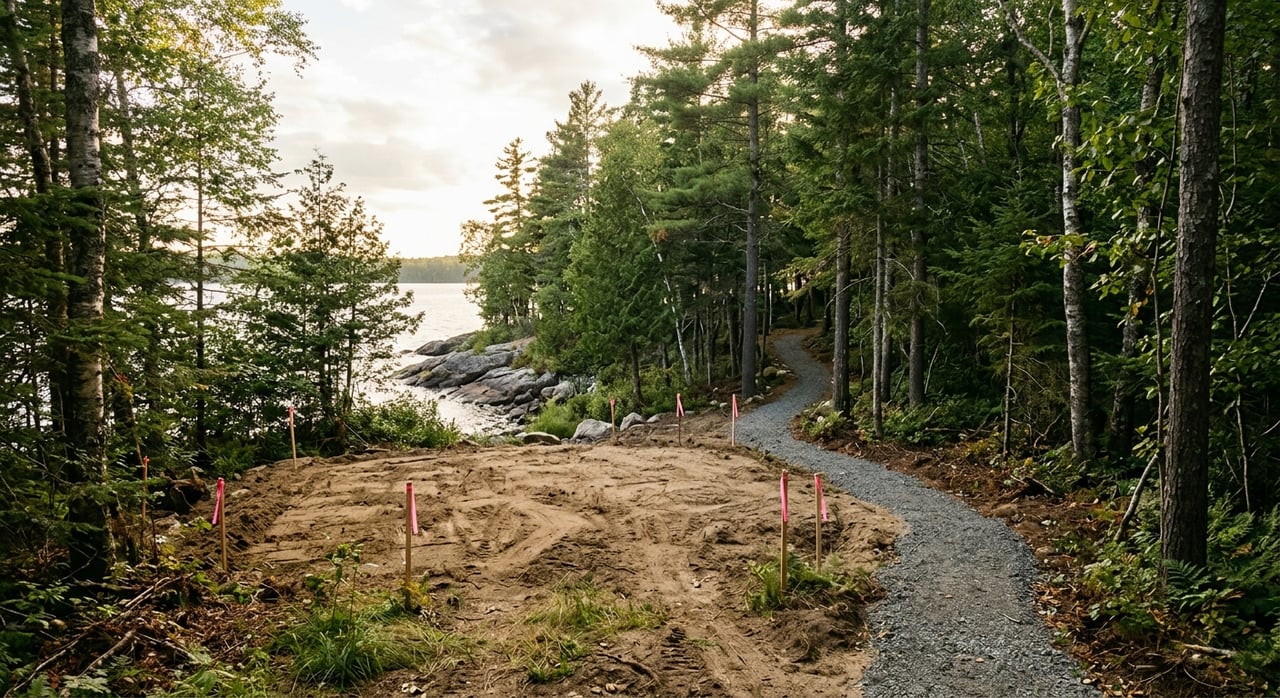
Access also affects the address process. In Otter Tail County, a driveway must already exist before an E911 address can be assigned for a habitable structure. So if you are evaluating a vacant lot, driveway placement is not a late-stage detail. It is part of the lot’s real buildability.
Survey Questions Can Affect Everything
On lake lots, small boundary or topography questions can turn into major planning issues. If the lot lines, easements, bluff edge, OHWL, or access route are unclear, bringing in a Minnesota-licensed land surveyor early can save time and money.
Otter Tail County requires surveys for all non-earthmoving conditional use permit applications. The county’s survey policy also calls for detailed information, including lot lines, road rights-of-way, structures, wells, septic systems if known, wetlands, the OHWL, and dimensions from structures to boundaries.
For buyers, that means a survey is not just a formality. It can help you understand whether the home site you imagine actually fits the property.
Septic Can Be the Make-or-Break Issue
For many vacant lake lots near Dent, septic feasibility is one of the biggest questions. Otter Tail County requires a permit to install a new or replacement septic system, and the process starts with a design from a licensed septic designer.
If public sewer is available, the property must connect to it. If not, the site must comply with Minnesota rules and county sanitation requirements.
This is why septic work should happen early, especially on tight sites. A lot may appear large enough, but once you account for setbacks, shoreline limits, topography, and driveway placement, the area left for a compliant septic system may be smaller than expected.
Wells Need Attention Too
If the lot will need a private well, that should also be part of your planning. In Minnesota, a new well must generally be constructed by a licensed well contractor, with limited owner-built exceptions.
Before drilling starts, a notification form and fee must be submitted to the Minnesota Department of Health. After the work is completed, the contractor must provide the owner and the state with the Well and Boring Record.
If there is already a well on the property, Minnesota law requires the seller to disclose the number and status of wells and provide a sketch map showing each well’s location before a purchase agreement is signed. Many buyers also want to plan ahead for water testing, since lenders often have their own requirements.
Shoreline Conditions Matter Long Term
Lakefront value is not only about views and frontage. Shoreline stability, slope, vegetation, and access to the water can all affect your costs, your permit path, and your future enjoyment of the property.
The DNR notes that shoreland areas often contain erodible soils and important habitat, which is why natural vegetation and conservative site design matter. On steep slopes and bluffs, natural vegetation is the preferred stabilization approach.
If erosion control is needed, riprap and other stabilization work may trigger both DNR review and local shoreland review. For bluff access, Otter Tail County says stairways and lifts are preferred for steep slopes, and they should be placed where they are least visible from the water when practical.
For docks, many shoreline properties do not need a permit for a typical dock. Even so, the DNR recommends the smallest and narrowest dock that reasonably meets your needs.
Small Lots May Still Have a Path
If a lake lot is smaller or narrower than current standards require, that does not always mean the property is unusable. But it does mean you need a closer review.
Otter Tail County’s variance process is the path for relief from setback, lot size, or similar standards. A variance is separate from a shoreland, structure, or septic permit, so it should not be treated as a shortcut.
If you are considering a nonconforming lot, it is wise to ask early what approvals may be needed and how that may affect timing, cost, and design flexibility.
Plan for a Realistic Timeline
Lake-lot purchases often move more slowly than buyers expect. A straightforward project may be fairly manageable, but approvals can add time quickly.
Otter Tail County says conditional use permits can take several months. Applications must be filed at least 21 days before a regularly scheduled Planning Commission meeting, and all CUP applications must include a survey.
Variance hearings are monthly, and subdivision of land under five acres must be reviewed and approved by Land and Resource Management before recording. If your lot needs more than one layer of review, building-season timing can become a real factor.
A Practical Due Diligence Sequence
If you want to reduce surprises, follow a simple order of operations before you close on a lake lot near Dent:
- Confirm jurisdiction to see whether the lot is inside city limits or under county review.
- Check shoreland status and identify the lake classification and setback rules.
- Review access to confirm road frontage, easements, and any county road approach needs.
- Order a survey early if boundaries, OHWL, bluff areas, or easements are unclear.
- Talk with county staff if the lot may need a variance, CUP, subdivision review, or shoreland permit.
- Bring in a septic designer early if the property will need a new septic system.
- Refine your building plan only after the true building envelope is understood.
This kind of step-by-step process is especially helpful with lakefront land, where one issue often affects three others.
Why Local Guidance Helps
A lake lot purchase near Dent is more than a land search. It is a coordination project involving location, shoreland rules, access, septic, survey work, and timing.
That is why buyers often benefit from working with someone who understands lakes-country property beyond the listing sheet. When you know what questions to ask early, you can avoid chasing a lot that does not fit your goals and focus on opportunities that truly make sense.
If you are thinking about buying a lake lot near Dent and want a steady, local perspective on access, shoreline constraints, and development potential, connect with Jason Bristlin. He helps buyers navigate lakefront land, rural acreage, and development-ready property with a clear, process-driven approach.
FAQs
What makes a lake lot near Dent buildable?
- A buildable lot typically depends on jurisdiction, shoreland status, lake classification, lot size and width, setbacks, access, and septic feasibility.
What is the ordinary high water level on an Otter Tail County lake lot?
- The ordinary high water level is the regulatory shoreline boundary used for setback and shoreland decisions in Minnesota.
Can you build on a nonconforming lake lot in Otter Tail County?
- Sometimes, but a smaller or narrower lot may need a variance or other county review before a project can move forward.
Do you need a permit for a driveway to a county road near Dent?
- Yes, if a new approach connects to a county road, Otter Tail County requires an approach application and reviews it for safety and access conditions.
Does a vacant lake lot near Dent need septic review?
- In many cases, yes. If public sewer is not available, the lot must support a compliant septic system under county and state rules.
Do most lake lots need a dock permit in Minnesota?
- Often no for a typical dock, but shoreline stabilization, grading, or other shoreline work can trigger additional review or permits.
How long do Otter Tail County land-use approvals take?
- Timing varies, but conditional use permits can take several months, and variance or subdivision review can add more time.
Who should you contact first about a lake lot near Dent?
- Start with the city if the lot is inside city limits. Outside city limits, county Land and Resource Management is the best first stop for shoreland, septic, variance, CUP, and subdivision questions.